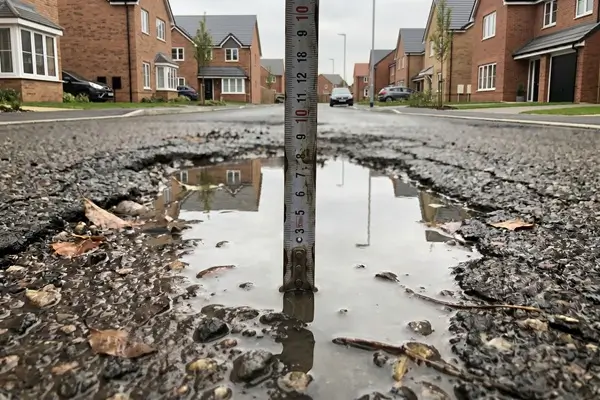
The first 5mm of rainfall is a small measurement with significant implications
The first few millimetres of rainfall may not sound like much, but in surface water management they matter.
With new housing developments now expected to retain the first 5mm of rainfall on site, developers, landscape architects and local authorities face a growing challenge: how do you manage everyday rain when space is already under pressure?
The first 5mm is important because it represents frequent, light rainfall – the kind that often creates the “first flush” of urban runoff. As rain washes across roofs, roads and hard surfaces, it can pick up oils, microplastics, metals and other pollutants before carrying them into drains, sewers and local waterways. Capturing this water at source helps reduce pollution, ease pressure on sewer networks and better mimic natural greenfield conditions, where rainfall is intercepted by vegetation, absorbed by soil or lost through evaporation.
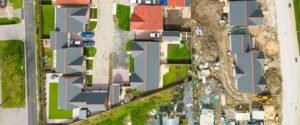
For many developments, however, space is limited. Roof areas, hardstanding, parking, utilities, access routes, tree pits, biodiversity requirements and public realm expectations are all competing for room. Traditional drainage infrastructure, such as oversized tanks or deeper below-ground attenuation, may not always be viable, desirable or sufficient on its own.
The answer is to make the whole system smarter.
From drainage assets to water management networks
The most effective SuDS strategies rarely depend on a single feature. They work as a connected management train, using a sequence of smaller interventions that slow, store, filter, reuse and release water in a controlled way.
This is particularly important for everyday rainfall. Rather than sending light rain straight into piped drainage, source-control features can manage water close to where it falls. Roof runoff, façade runoff, courtyard drainage and hardstanding can all be intercepted before water places unnecessary pressure on drains and sewers. Essentially, the idea is to treat SuDS as part of the landscape, rather than as an afterthought.
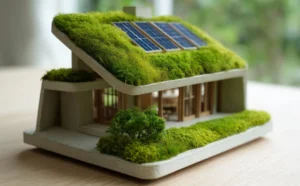
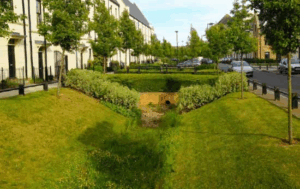
A green or blue wall, for example, can do more than soften a building elevation. It can intercept rainfall, support planting, provide biodiversity value and direct excess water into a connected storage or reuse system. A smart water butt can capture roof runoff, hold water for later use and, where appropriate, release capacity ahead of forecast rainfall. A SuDS planter can provide attenuation, filtration and habitat within a compact footprint. A rain garden can receive flows from adjacent surfaces, support infiltration and create a planted feature that improves the quality of the public realm.
Individually, each element has value. Connected, they become more than the sum of their parts.
Learning from countries already designing for water resilience
While the UK is now placing greater emphasis on retaining rainfall at source, other countries have been embedding this thinking into urban design for many years. The Netherlands is a useful example. Dutch cities have long treated rainwater management as part of the public realm, not simply as an engineering issue hidden below ground.
Rotterdam’s water squares and Amsterdam’s Rainproof project approach show how water-sensitive design can be visible, multifunctional and integrated into streets, buildings, landscapes and community spaces. The UK is not being asked to adopt an untested idea; it is catching up with principles already proven elsewhere.
The opportunity now is to apply those lessons in a way that fits UK housing, commercial development, public realm and retrofit projects. For BluWater Solutions, this means helping design teams move beyond isolated products and towards connected green-blue infrastructure systems.
Why one product is rarely enough
A single drainage product may solve one part of the problem, but sites are rarely that simple.
A tank can store water, but it may do little for biodiversity, amenity or water quality. A rain garden can provide excellent natural performance but may not have enough space to manage all roof runoff alone. A water butt can support reuse, but without complementary overflow routes, its capacity may not always be available when needed. A planter can slow and filter flows but may perform best when integrated into a wider network of source-control features.
This is why SuDS design increasingly needs to be approached as a kit of parts.
On a compact residential scheme, that might mean linking downpipes to smart water butts, with overflows directed into SuDS planters or rain gardens. In a school or university setting, it could involve green walls, rain gardens and visible planters that double as outdoor learning resources. For local authorities, modular SuDS features can be added to streets, parks and public buildings as part of wider climate resilience, biodiversity or combined sewer overflow reduction programmes.
The aim is not to force every site into the same specification. It is to select the right combination of measures for the site conditions, available space, maintenance model and design ambition.
Turning rainfall into a resource
One of the most important shifts in SuDS thinking is the idea that rainwater is not simply a waste product to be drained away. It is a resource.
Rainwater matters during storms, but also during dry periods. Recent years have shown how quickly the UK can move from intense rainfall to drought conditions and hosepipe bans. For homeowners, schools, community gardens and developments with biodiverse planting, this creates a practical issue. Planting schemes are increasingly expected to deliver habitat, cooling, amenity and even food-growing benefits, but those landscapes need water to establish and survive.
Retaining rainwater on site helps address this challenge. When captured close to source, rainwater can be reused to irrigate trees, living walls, planters, raised beds, fruit, vegetables and herbs. Smart water butts and connected storage systems can play a particularly valuable role here, especially when used alongside green roofs, green walls, SuDS planters and rain gardens.
In this type of system, water follows a more natural and useful pathway. Rain lands on a roof or façade. It is intercepted by planting where possible. Runoff is captured and stored and can then be reused for irrigation. Excess flows can be filtered through planted SuDS features before being attenuated, infiltrated or released at a controlled rate.
This approach supports both flood resilience and drought resilience. It recognises that the climate challenge is not only too much water at once, but also longer dry periods when landscapes need support to remain healthy and functional.
A smarter response to the first 5mm
The first 5mm of rainfall is a small measurement with significant implications. It asks designers, developers and asset managers to think differently about everyday rain: where it lands, how it moves, how it can be held, and how it can be reused or returned to the environment more naturally.
For space-constrained sites, the solution will often be found not in one larger tank or one deeper excavation, but in a series of connected, landscape-led interventions.
By combining smart storage, planted attenuation, rainwater reuse, vertical greening and rain gardens, BluWater Solutions helps turn compliance into something more valuable: a practical, nature-based water management strategy that supports biodiversity, improves place quality and builds resilience into the everyday landscape.
The future of SuDS is not simply about draining water away. It is about designing systems that allow water, planting, people and wildlife to thrive together.
As part of the BioScapes Group, this joined-up thinking sits at the heart of our work to influence how landscapes are planned and delivered. It reflects an integrated approach to landscaping that considers water alongside biodiversity, soil health and long-term performance. By designing systems where these elements work together, it becomes possible to create places that respond to everyday rainfall, support thriving ecosystems and remain resilient as conditions change.
Explore our solutions or get in touch with our team to find out how we can support smarter water management strategies today.